
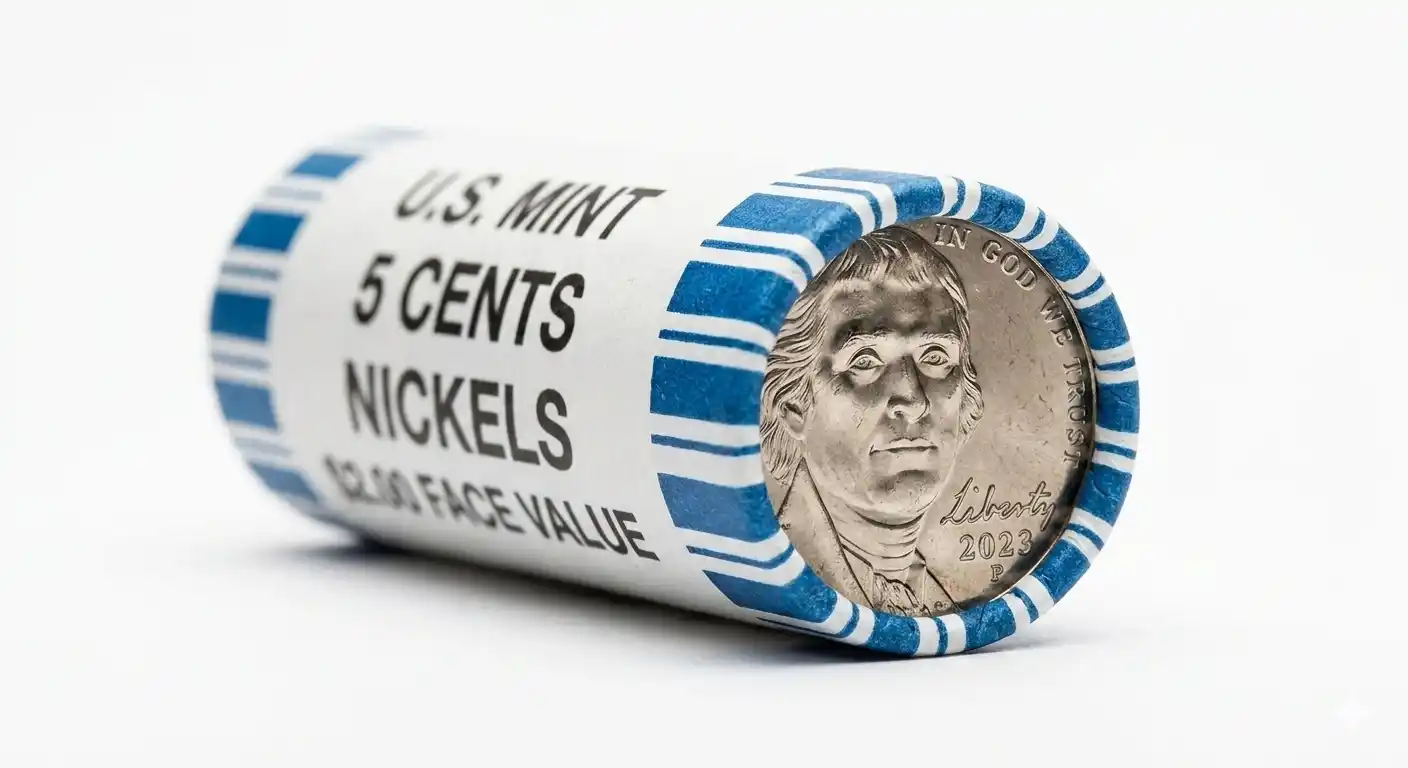
The structure of a roll tells more than the quantity.
Banking packaging for 5-cent coins follows strict standards set by the Federal Reserve System.
Maintaining these regulations ensures inventory accuracy within large cash processing centers.
Automated packaging lines eliminate discrepancies in the number of units inside paper or plastic tubes.
Analyzing roll structures allows for the identification of technological anomalies from the mint.
See how many nickels in a roll:
Packaging Parameter | Standard Value |
Quantity of coins | 40 units |
Face Value | $2.00 |
Identification Color | Blue |
Net Roll Weight | 200.00 grams |
Total package weight might fluctuate slightly depending on the density of the paper used.
Exceeding the weight by 5.00 grams suggests the presence of foreign objects or incorrect coin types.
Bank tellers verify these rolls by weighing entire boxes in bulk.
Standard boxes contains 50 rolls with a total value of $100.00.
Technical Profile of the Jefferson Nickel
Physical characteristics of this coin have remained consistent over several decades.
Precise knowledge of these data points is essential for operating weight-based counting machines.
Technical Dimensions:
Unit Mass: 5.000 grams
Disk Diameter: 21.21 mm
Edge Thickness: 1.95 mm
Metal Composition: 75% Copper and 25% Nickel
Edge Type: Plain
Metal ratios in this alloy provide high wear resistance during intensive circulation.
Absence of reeding on the edge simplifies the striking process while reducing production costs.
Coin weight being a multiple of five grams facilitates calculations without digital scales.
Historical Composition Shifts: "Wartime" Nickels
Metal composition underwent radical changes between 1942 and 1945 due to raw material shortages.
Military requirements demanded the redirection of Nickel to defense industries.
Wartime Nickel Composition:
Silver: 35%
Copper: 56%
Manganese: 9%
Mass for these coins remained constant at 5.000 grams.
Large mint marks placed above the Monticello dome serve as the primary distinguishing feature.
Prices for these rolls in 2026 depend heavily on the current market value of Silver.
Pure Silver weight in a single 1942–1945 roll totals approximately 70.00 grams.
Auction Records and Market Value of Rarities
Value for individual coins within a roll is determined by preservation state and release scarcity.
Sales statistics from 2025–2026 indicate price growth for top-tier specimens.
Coin and Year | Condition | 2024 Price | 2026 Price | Growth |
1913 Liberty Head | Proof 66 | $4,200,000 | $4,850,000 | +15.4% |
1918/7-D Buffalo | MS65 | $280,000 | $315,000 | +12.5% |
1939-D Reverse 40 | MS67 | $22,000 | $26,400 | +20% |
Record amounts are paid for coins possessing original mint luster.
Attaining Full Steps status for Jefferson nickels remains a critical price factor.
This status confirms the presence of five or six distinct steps on the Monticello building.
Lacking sharp steps reduces the value of an MS65 coin by several orders of magnitude.
Design Evolution and Packaging Scarcity
US five-cent coin history is divided into several significant eras.
Unique packaging characteristics define each design type.
Shield Nickel (1866–1883): initial Copper and Nickel issues. Original rolls are virtually non-existent, surviving mostly as scattered sets.
Liberty Head (1883–1912): Charles Barber's design. The 1885 issue remains a key date with a mintage below 1.5 million units.
Buffalo Nickel (1913–1938): Native American and Bison imagery. Denver mint issues from the 1920s show the highest value appreciation.
Jefferson Nickel (1938 — Present): the modern standard. Obverse designs were updated in 2005 and 2006 under the Westward Journey program.
Four different reverse designs were featured in the 2004–2005 program.
Mintage for these coins was massive, reaching hundreds of millions of units.
Finding these years in original bank packaging is relatively simple.
Technological Errors as Price Drivers
Striking errors transform a common roll into a high-demand investment object.
Modern equipment reduces defect percentages, increasing the value of older finds.
→ 1937-D "3-Legged Buffalo" error → Excessive die polishing → $2,000 — $40,000
→ 2005-D "Speared Bison" error → Deep die scratch → $200 — $1,500
→ 1955 Double Die → Hub misalignment → $300 — $1,200
Discovering such defects in bank rolls has become extremely rare in 2026.
Professional hunters have already extracted most valuable coins from circulation.
Automated sorters in banks help filter out coins with non-standard geometry.
Investment Portfolio Mechanics
Investing in unopened rolls requires a long-term strategy and the coin value checker.
Owning an original bank roll guarantees that coins have had no skin contact.
Advantages of Roll Preservation:
Maintenance of natural patina and luster
Compact storage for large capital volumes
Liquidity when selling in bulk lots at auctions
Potential for discovering high-grade coins upon opening
A 1950-D Jefferson Nickel roll currently costs approximately $400.00.
Low mintage of 2.6 million units for that year ensures price stability.
Annual appreciation for rare rolls in the 2020s averaged 5–8%.
Wear Factors and Condition Grading
Coins inside rolls can sustain defects during the packaging process.
Contact between coins falling into a hopper leaves microscopic marks.
Mint State (MS): no evidence of circulation wear. A 1943-S coin in MS67 reaches $3,000.
About Uncirculated (AU): minor rubbing on Jefferson’s hair. Value drops to $15.00 for a similar date.
Very Fine (VF): noticeable wear on facial details. The coin is valued at face value or metal weight.
Professional grading services utilize a scale from 1 to 70 points.
Differences between 66 and 67 points can mean thousands of dollars.
Digital grading using artificial intelligence has become the precision standard in 2026.
Mintage Comparative Analysis 2020–2026
Production volumes fluctuate based on economic needs.
Post-pandemic shifts in payment habits have impacted statistics.
Year | Mint | Mintage (Millions) | Current Status |
2020 | Philadelphia | 711.3 | Common |
2021 | Denver | 794.8 | Common |
2023 | Philadelphia | 642.1 | Above Average |
2025 | Denver | 510.4 | Limited |
Decreasing mintage in 2025 stems from the rise in digital payments.
Rolls from 2025 may become deficit items in 10–15 years.
Banks in 2026 order 20% fewer coins than a decade ago.
This leads to the gradual aging of the coin supply currently in circulation.
Logistics and Secure Storage
Heads-of-state weight for nickel boxes requires specific transport conditions.
One box weighs approximately ten kilograms.
Utilizing plastic containers prevents damage to the paper wrappers.
Damaged wrappers reduce the value of a roll as a collectible object.
Ideal Storage Conditions:
Temperature: 18–22 degrees Celsius
Humidity: below 40%
Absence of aggressive airborne vapors
Use of moisture-resistant safes
Nickel remains susceptible to corrosion when contacting chlorides or sulfur.
Appearance of green spots on coin surfaces indicates a breach in storage conditions.
Cleaning coins with chemicals destroys collectible value permanently.
Role of Numismatic Dealers in 2026
Online platforms have made the coin market completely transparent.
Prices update in real-time based on global auction data.
Dealers verify rolls to ensure the authenticity of the packaging.
Verification Methods:
Ultraviolet scanning to check paper type
Analyzing the crimp style on roll ends
Comparing printing fonts on the wrapper
And using the free coin apps
Counterfeit rolls filled with modern coins and rare samples only on the ends do exist.
Purchasing from certified numismatic association members minimizes risks.
Dealer reputation in 2026 is confirmed via blockchain transaction certificates.
Technical Details of "Full Steps" Analysis
Steps on the Monticello manor are the most difficult elements to strike.
Die wear leads to the smoothing of these thin lines.
5 Full Steps: presence of five complete lines without breaks
6 Full Steps: maximum detail, extremely rare for certain years
Soft Strike: absence of sharp steps despite full preservation of other details
Attaining Full Steps makes a 1953-S specimen unique.
Prices for such a coin in MS65 can reach $20,000.
A standard specimen of the same year and grade costs less than $10.00.
This gap is explained by technological difficulties at the San Francisco mint during that period.
Future of the Five-Cent Coin in the Monetary System
Discussions regarding the feasibility of producing 5-cent coins continue in government.
Production costs for a single coin in 2026 reach approximately 8.5 cents.
Manufacturing losses force the consideration of alloy changes.
Possible Development Scenarios:
→ Replacing Nickel with Steel using a galvanized coating
→ Complete withdrawal of the 5-cent denomination
→ Reducing coin diameter and weight
Any change in parameters will immediately turn current rolls into historical artifacts.
Investors closely monitor legislative initiatives from the finance committee.
Halting production would cause an explosive price rise for sealed bank boxes.
Mathematical Probability Models
Searching for rare coins in modern rolls relies on the theory of large numbers.
Probability of finding a 1943 Silver nickel in a standard 2026 bank roll is extremely low.
Statistics indicate one "Wartime" nickel for every 4,000 inspected coins.
Inspecting 100 rolls ($200) → 1–2 Silver coins
Inspecting 1,000 rolls ($2,000) → Finding pre-1938 coins
Time Profitability: extremely low for manual searching
Using automated image recognition systems accelerates the process ten-fold.
Professional hunters use conveyor belts equipped with high-resolution cameras.
This transforms numismatics from a hobby into a high-tech mass currency processing operation.