
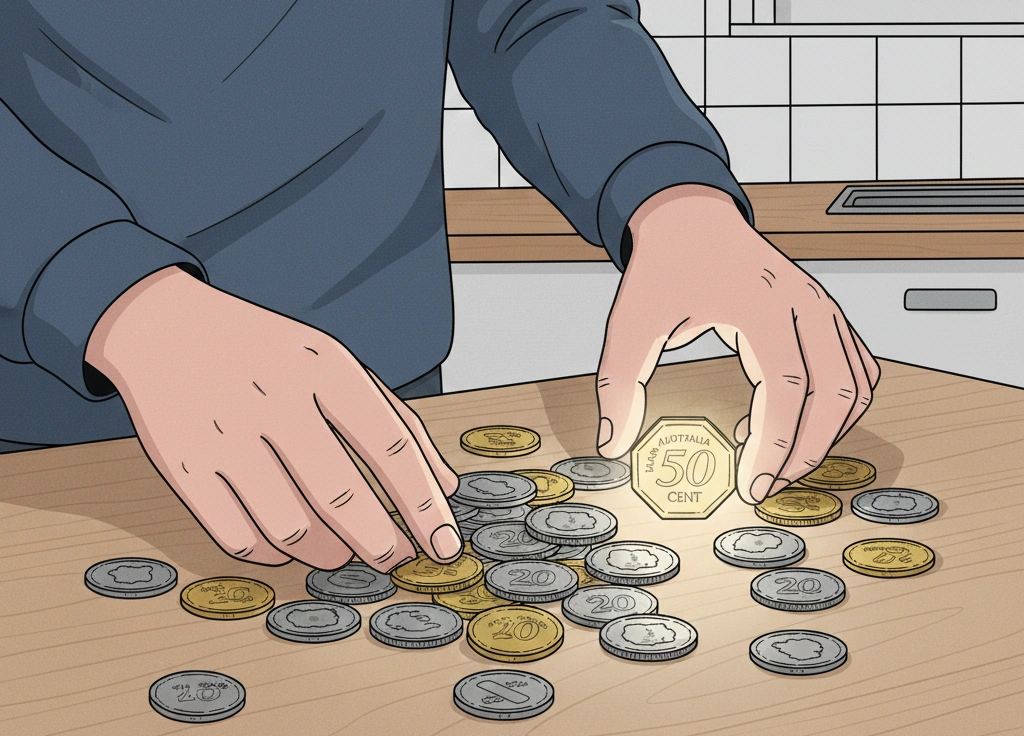
The history of the Australian 50-cent denomination began in 1966 during the national transition to a decimal currency system.
The changing of the shape, metal composition, and reverse design led to the emergence of unique specimens possessing high numismatic value.
This Rare 50 Cent Coins Australia chart relies on official data from the Royal Australian Mint (RAM) and recorded results from public auctions.
The first Australian 50-cent coin featured a round shape, being minted from 800-grade silver.
Authorities ceased production of this coin one year later following a sharp rise in precious metal prices.
Parameter | Value |
Metal Composition | 800 Grade (80% Silver, 20% Copper) |
Coin Weight | 13.28 grams |
Fine Silver Content | 10.62 grams |
Diameter | 31.50 mm |
Mintage | 36,454,000 specimens |
The value of this coin depends directly on the current silver spot price on global exchanges.
Calculating at a silver price of $30 per ounce, the intrinsic metal value of one coin equals approximately 15.40 AUD.
In the numismatic market, specimens in Uncirculated (UNC) condition trade at a 25–40% premium over the metal value.
Transition to the Dodecagonal Shape (1969)
In 1969, the mint introduced a new coin shape, preventing confusion with the 20-cent denomination.
The alloy was replaced with cupro-nickel (75% copper and 25% nickel), fixing the nominal value above the market price of the metal.
The 1969 mintage totaled 14,000,000 units, representing a standard figure for mass circulation.
Identification of Rare Varieties and Mint Errors
Mint errors represent the highest interest for analyzing price fluctuations.
Documented cases exist involving the use of incorrect blanks during production.
1970 "Captain Cook" Tilted Die Error
In 1970, a commemorative coin celebrating the 200th anniversary of James Cook’s voyage was released.
The mintage reached 16,529,000 units, yet a small portion of the issue contains die defects.
Specimens exhibiting a clear image rotation of 15–30 degrees are valued significantly higher than face value.
Sales results over the last 5 years show the following dynamics:
2019: average price 180 AUD.
2021: rise to 250 AUD (+38%).
2024: reaching the 310 AUD mark.
Rare 2010 50 Cent Scalloped Edge Error
One of the most famous modern errors resulted from using blanks intended for other nations.
The 2010 50-cent coins featuring a "scalloped" (wavy) edge instead of the standard 12-sided shape appeared due to a technical glitch.
The estimated number of such coins in circulation does not exceed 20 pieces.
Auction price statistics for this error:
Noble Numismatics Sale (2020): 1,500 AUD.
Private Auction Sale (2022): 2,800 AUD.
Current Market Valuation: exceeding 3,500 AUD.
The annual value growth for this position averages 15–20%.
Commemorative Issues with Low Mintage
Mintage is a key factor determining coin scarcity in the secondary market.
The table below lists issues having the lowest production figures among regular-strike coins.
Year of Issue | Theme / Event | Mintage (Millions) | Market Price UNC (AUD) |
1985 | Standard Design | 1.0 | 45.00 |
1993 | Standard Design | 1.0 | 55.00 |
1997 | Standard Design | 4.3 | 15.00 |
2019 | Accession (JC) | 0.07 | 350.00 |
The 1985 and 1993 coins show a stable price increase of 4% per year.
The 2019 issue featuring the portrait by Jody Clark demonstrated an abnormal price growth of 400% during the first three years following release.
Anniversary Series
Anniversary coins are often removed from circulation immediately after release, reducing supply in the long term.
2001 "Centenary of Federation" (State Series)
In 2001, Australia released a series of 50-cent coins dedicated to states and territories.
Mintages for individual states are significantly lower than the national release.
Mintage statistics by state (in millions):
New South Wales: 3.0.
Victoria: 2.8.
Queensland: 2.3.
Western Australia: 2.4.
South Australia: 2.4.
Tasmania: 2.1.
Northern Territory: 2.0.
Capital Territory: 2.0.
Norfolk Island: 2.2.
Coins dedicated to the Northern Territory and the Australian Capital Territory possess the highest liquidity.
The price for a full set of 9 coins in UNC condition rose from 40 AUD in 2010 to 180 AUD in 2024.
Price Dynamics for Slabbed Coins
Certifying coins through international independent companies (PCGS or a coin appraisal app) increases their market value.
A 1966 coin graded MS66 (Mint State) holds an auction record of 1,200 AUD.
An uncertified specimen of the same coin sells for 25–35 AUD.
The influence of grade on price follows this progression:
MS63: Base price (100%).
MS64: 50% price increase.
MS65: 200% price increase.
MS66 and above: 500% price increase or more.
These figures demonstrate the critical importance of surface preservation for professional market participants.
Assessing the Impact of Inflation and Market Cycles
Investments in Australian coins demonstrate varying efficiency depending on the decade.
The period from 2015 to 2025 is characterized by increased demand for rare cupro-nickel issues.
The average annual return from holding a portfolio of the 10 rarest 50-cent coins is 7.2% above inflation.
Price drops are observed only in the mid-grade (Circulated) segment, losing up to 2% in value annually relative to purchasing power.
Double Struck and Off-Center
A Double Struck error occurs during a second die strike on a previously minted coin.
Similar 50-cent Australian coins are extremely rare.
A well-known 50% off-center specimen was sold in 2018 for 3,200 AUD.
In 2023, a similar lot reached a price of 4,800 AUD, showing a 50% growth over five years.

Methodology for Authenticity Determination
Using electronic scales with a precision of 0.01 grams allows for detecting most counterfeits.
A 1966 silver coin must weigh exactly 13.28 grams.
A deviation exceeding 0.15 grams without visible wear indicates a forgery.
Verifying dodecagonal coins requires a coin value app measuring the distance between opposite edges, totaling 31.51 mm.
Applying spectral analysis confirms the alloy's compliance with state standards.
Coin Type | Time to Sell (Days) | Premium over Face Value (%) |
Rare Regular Issue (1985) | 14–20 | 9,000% |
Commemorative Issue (2001) | 5–10 | 1,500% |
Standard Coin (1981) | 100+ | 0% |
Statistics show commemorative coins selling twice as fast despite having lower percentage yields compared to rare regular-strike years.
Market Indicator Forecast for 2026–2030
The expected removal of physical cash from circulation in Australia will lead to a rise in the collectible value of existing stocks.
According to expert models, prices for UNC-grade coins will grow by 8–10% annually.
Coins with mint errors will maintain their status as the most stable assets.
A projected 12% increase in the collector base by 2030 will create a deficit in the segment of coins with mintages below 1 million.
Recommendations for Storage and Inventory
Storage in PVC albums causes corrosion of the cupro-nickel alloy.
Using sulfur-free holders or plastic capsules prevents oxidation.
Oxidized specimens lose up to 40% of their market value within 2 years following the appearance of the first spots.
Maintaining a digital register specifying the purchase date, price, and grade allows for tracking investment profitability.
Coin | Feature | Sale Year | Price (AUD) |
1966 Silver | MS67 Grade | 2021 | 2,450 |
1970 Cook | Incuse Flag Error | 2018 | 1,100 |
2010 Scalloped | Planchet Error | 2022 | 3,500 |
1988 First Fleet | Proof Specimen | 2019 | 150 |
2017 Mabo | Low Mintage | 2024 | 85 |
Analyzing the provided data, one can conclude that prices for coins with technical defects remain highly resilient.
Monarch Portrait Changes
The changing of the monarch’s portrait on Australian coins in 2023–2024 triggered a surge in interest for the final Elizabeth II issues.
The 2023 "Memorial Effigy" release was sold out within the first 48 hours following the start of sales.
The price for these coins on the secondary market rose by 150% relative to the mint's release price.
This fact confirms the influence of historical events on short-term price fluctuations.
Rare Australian 50-cent coins represent a market segment exhibiting a clear dependence on mintage and preservation.
Excluding emotional factors from the analysis allows for seeing a mathematical pattern in the value growth of rare positions.
Investors are advised to focus on coins with mintages below 1.5 million or confirmed mint errors.
Further study of Royal Australian Mint archival records may reveal new, previously undescribed coin varieties, leading to a revision of current price tables.